Finding the Perfect Meme Coin Entry Point
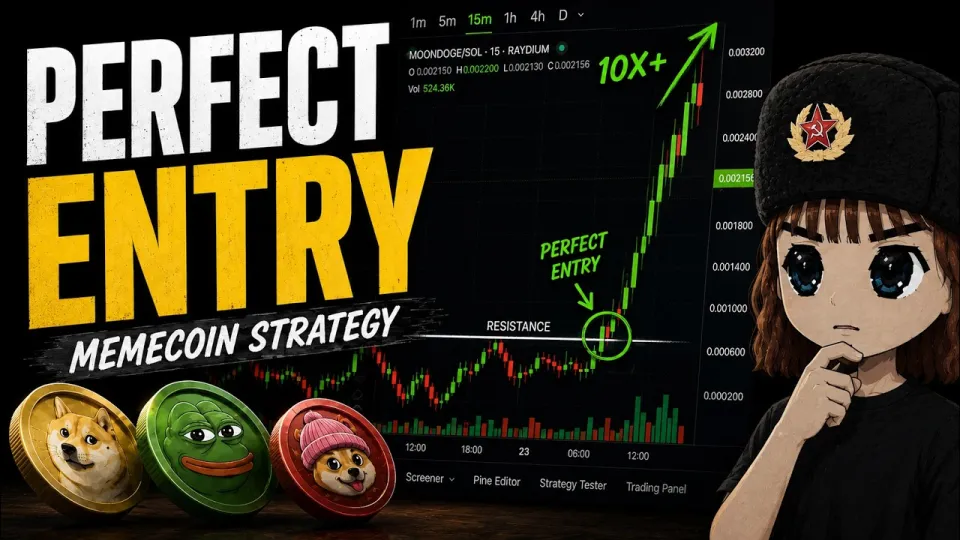
Video: How I Find the PERFECT Entry on Memecoins 📈 (Full Strategy)
Want articles like this for your own video to promote it on YouTube and Google? Order them through the Telegram bot @sat_sit_bot. Articles with your video embedded are written and posted by the bot itself — on popular topical sites (no ads). Try it free: 50 articles on us.
· based on the channel starwifpump
Key takeaways
- Most meme coin losses come from bad timing, not bad coin selection — entry price sets the entire risk-to-reward ratio.
- A valid setup needs three confirmations: momentum, a pullback into support, and a level that invalidates the idea if broken.
- Chasing green candles and buying on FOMO is the single most common entry mistake among new traders.
- Risk, exit targets and profit-taking levels should be planned before the position is opened, not after.
- Tools like Plasma and Axiom are used to paper trade, snipe and track positions across Solana meme coins.
A meme coin entry is the price level at which you open a position, and the quality of that level decides most of your risk-to-reward before the coin even moves. Traders rarely lose because they picked the wrong token — they lose because they bought the top of a green candle with no plan for where they would be wrong. The full breakdown of this process comes from starwifpump's strategy video, and the tool stack he points viewers to starts with the Plasma Telegram early-access group, where paper trading, sniping and copy trading sit in one place.
Why entry timing matters more than coin selection
A meme coin can be a genuinely good pick and still produce a losing trade if you enter after the move has already happened. The same token bought on a pullback into support and bought at the local high are two completely different trades: same asset, opposite risk profiles.
This is why the process should be repeatable rather than emotional. Instead of asking "is this coin going to pump?", the question becomes "is this a level where I can be wrong cheaply?". That reframing is the core of the strategy — you are not predicting every move, you are filtering for setups where the distance to invalidation is small and the distance to the first target is large.
The three confirmations behind a valid setup
A high-quality entry in meme coins usually requires three things to line up at once, and skipping any one of them turns a trade into a guess.
- Momentum is already present. Volume and price expansion show that buyers are actually in the market. Buying a flat chart hoping for a pump is not a setup; it is a lottery ticket.
- Price pulls back into a reference level. That level can be a prior consolidation zone, a broken resistance now acting as support, or a moving average that has held on previous dips. The pullback is what gives you a defined entry rather than a chase.
- There is a clear invalidation point. If price closes below the support that justified the trade, the idea is dead and you exit. Without this level, you cannot size the position or calculate risk.
Momentum without a pullback is a chase. A pullback without momentum is a falling knife. A pullback with momentum but no invalidation level is an unmanageable position.
How to enter on a pullback without chasing the pump
The practical rule is to let the first impulse pass and buy the reaction to it, not the impulse itself. On a fast-moving Solana meme coin this often means waiting through a vertical candle that feels like the opportunity of the day.
A workable sequence looks like this:
- Identify the coin while volume is rising, not after it has already printed several green candles.
- Mark the base or consolidation that preceded the move — that zone is your reference for a retest.
- Wait for price to come back into that zone while volume cools off rather than collapsing entirely.
- Enter in the zone with a stop below it, so the risk is defined by structure rather than by a random percentage.
- If price never pulls back, accept the missed trade. There is always another coin.
Patience is the part most beginners skip, and it is the part that separates a repeatable process from a series of emotional decisions.
Red flags that tell you not to enter
Some charts actively warn you away, and recognising them saves more money than any entry pattern.
- Vertical candles with no consolidation. Late buyers hold the bag when the first real pullback arrives.
- Volume fading while price holds or drifts up. Momentum is leaving the move even though the chart still looks healthy.
- A breakdown below the level that started the move. Once structure is broken, the setup no longer exists — do not average down into it.
- A chart that has already run for hours without a meaningful retrace. The remaining upside is smaller than the downside if the move unwinds.
- Entering only because of a narrative or a tweet. Narrative is a reason to watch a coin, not a reason to buy it at any price.
Planning risk, exits and profit-taking before the trade
Risk planning happens before the position exists, not after it goes against you. The simplest version is to define three numbers in advance: entry, invalidation, and first target.
If you enter at a support retest with invalidation just below that support, your stop distance is small and known. That lets you size the position so a single loss does not damage the account, which matters far more in meme coins than in large-cap assets because drawdowns can be violent and fast.
Profit-taking should also be staged. Scaling out at the first target locks in the trade and removes the pressure to guess the top, while leaving a portion open for an extended move. The exact percentages are a personal choice, but the decision has to be made in advance — deciding mid-candle is how winning trades turn into round trips.
Common questions from newer traders
Beginners tend to raise the same three issues: which filters to use in trackers, how to catch tweets or narratives before a coin pumps, and whether the same approach works across chains.
On trackers, the useful filters are the ones that remove noise rather than add it — liquidity and volume thresholds, age of the pair, and holder distribution. On narratives, no tracker reliably tells you which post will move a coin; what you can control is whether you enter on structure or on a headline. On chains, the mechanics of momentum, pullback and invalidation are universal, but liquidity depth and execution speed differ, so position sizing and stop placement need to adapt to the chain you are trading.
There is also the question of capital. Trading a small account with money you cannot afford to lose turns every pullback into panic, which destroys the discipline the whole method depends on.
Useful links
- Plasma early access and trading tools: https://t.me/+PF-2KHPgQqFiZWJh
- Discord community: https://discord.com/invite/fr6zzYyBxC
- Padre terminal access: https://trade.padre.gg/rk/star
- Solpump: https://solpump.com/a/STARGOAT
- starwifpump on X: https://x.com/starwifpump
- Axiom terminal early access: https://axiom.trade/@stargoat
- Astrum extension: https://chromewebstore.google.com/detail/plasma-trade/ddealojceghddkopmbfnkajmnadheddn
- GMGN VIP access: https://gmgn.ai/r/stargoat
The takeaway on meme coin entries
Entry quality is a process problem, not a prediction problem. Waiting for momentum plus a pullback plus a defined invalidation level filters out most of the trades that ruin accounts, and it costs you nothing but patience. starwifpump builds the entire strategy around that idea: analyse the chart first, plan risk and exits second, and only then consider clicking buy. If you want the full toolset used in the breakdown, start with the Plasma Telegram group and paper trade the setups before risking real capital.
Source: How I Find the PERFECT Entry on Memecoins 📈 (Full Strategy) · Markdown version
Questions & answers
What is the best entry point for a meme coin?
The strongest entries come from a pullback into a reference level — a prior consolidation zone or broken resistance acting as support — after momentum has already appeared in volume and price. That combination gives you a defined invalidation point, which is what makes the trade manageable.
How do I avoid FOMO when a meme coin is pumping?
Accept in advance that you will miss some vertical moves, and only trade setups where price returns to your marked level. If the coin never pulls back, skip it — chasing a green candle removes your invalidation point and turns a planned trade into a guess.
Do I need special tools or trackers to find entries?
Trackers help you filter for liquidity, volume and pair age, but they cannot tell you where to enter. The entry decision comes from the chart structure, and terminals such as Plasma or Axiom mainly speed up execution, sniping and position tracking.
Does this entry approach work on chains other than Solana?
The logic of momentum, pullback and invalidation applies to any chain, because it describes how price moves. What changes is liquidity depth and execution speed, so position sizing and stop placement should be adjusted to the chain you are actually trading.